


Updated
19 Jun 2019

English expressions
There may be a few good reasons to use the "complicated word":
Cases where the "complicated word" may be justified also include legal matters, where that word may have a very precise meaning.
Some of the examples below are blatantly popular, others are less.
| Profound | Deep |
| Facile | Easy |
| Aubergine | Eggplant |
| Sorbet | Sherbet |
| Apartment | Flat |
The English language seems to be very flexible in using nouns as verbs. The dictionary contains hundreds of words that can be used as a verb or as a noun, such as age, blur, blush, board, coach, cruise, fire, help, list, note, swim. The list is almost endless. Interestingly, most of these words are very short. Examples: age as a verb: "This wine is ageing particularly well"; swim as a noun: "Let's have a nice swim before lunch".
Nevertheless, when the Human Resource Manager (I hate this term in any language) of my company sends a note saying:
"She will transition into her new role immediately"
I can't help being shocked. To start with, this is a barbarism: the word "transition" does not exist in the dictionary as a verb. Secondly, the expression is ugly; but you will tell me this is a matter of taste. Thirdly, all words ending in "-tion" are nouns, and originate from latine words that are nouns as well. There are only rare examples of words in "-tion" used as nouns and verbs, one coming to my mind is "partition", which has a quite technical meaning.
To me, this neologism is not necessary. The HR manager could as well have said: "She is moving into her new job immediately".
You are not going to say "Romeo passions Juliet", are you?
My Collins English dictionary knows only the noun "leverage" and defines it as: 1) the action of a lever 2) the mechanical advantage gained by employing a lever 3) power to accomplish something; strategic advantage. My Collins Dictionary is the 1979 edition. The on-line Webster dictionary has an entry for the verb "to leverage", defines it as "to use for gain or exploit" and gives the date of 1957 for its first appearance. Another example of the "noun as verb" trend shown just above.
Today, my company hardly issues a press release without using that verb at least once, preferably several times. The problem is that verb is so vague that everybody assigns it a different meaning. If you visit multilingual internet forums, you will see that we non-native speakers of the English language are struggling to translate that verb. My conclusion: leverage is another of these buzzwords that have little more merit than express their speakers' vanity and confuse their audience. See my link "Corporate lingo" below.
Deutsch
Warum hört man (scheinbar nur in Deutschland) immer wieder das Wort "Problematik" wenn ein gewöhnliches Problem gemeint wird? Neuerdings habe ich auch "Thematik" gehört, wo "Thema" eigentlich genügt hätte.
Ein weiteres Beispiel von "trendy language": siehe Larry King (auf Englisch) unten.
Seit ca. 2003 haben beide Wörter Problematik und Thematik, dazu noch im Plural, auch die französische Journalistensprache infiziert...
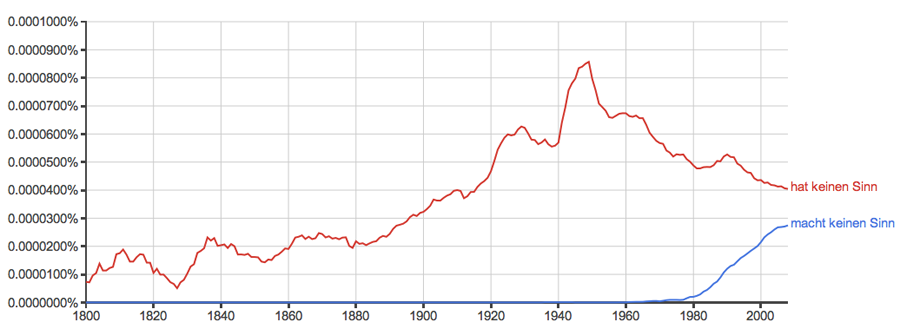 Es macht keinen Sinn
Ein typischer Anglicismus. Bis vor fünfzig Jahren existierte der Ausdruck gar nicht (Grafik anklicken). Korrekt ist "Es hat keinen Sinn", oder "Es ergibt keinen Sinn".
Linkguistics (français ailleurs)
 |
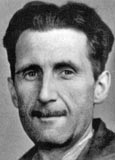
George Orwell : Politics and the English Language
Orwell wrote this text in 1946. Here the gist of it, summary rules written by Orwell himself:
External link of my original source. |
 |
|
Larry King : use simple language
I have discovered recently a press cutting I was keeping since 1996. I (unconsciously) took over some of its contents in the above paragraphs a few months ago... See the original: what Larry King, the famous American TV star, says about trendy language. You will see that it is, 40 years later, very similar to the ideas of Orwell. |
 |
|
Corporate lingo
The sort of nonsense you can read in these zombie sentences (external link) is unfortunately common in the industrial world, and is published everywhere on the world wide web. In French, this is called "langue de bois", or wooden tongue, I don't know why. The result is an apparence of content and a reality of emptiness. |
|
|
The 50 Most Widely Spoken Languages in the World: Spanish is second after Chinese, French is thirteenth after Hindi and German... | |
|
The numbers from 1 to 10 in ca. 4000 languages. This site is absolutely incredible. Known, unknown, dead (Sanskrit, Latin), living, written, non-written (Swiss-German, Creoles, Pidgins), artificial (Esperanto, Interlingua, Volapük) languages, try to find one not listed! Comments are in French, but most tables are in English. | |
|
See Writing and Language: a serious, concise set of pages about how to write (American) English, easily confused and frequently misspelled words, punctuation etc. Many of my American colleagues would benefit from this small treatise... Have a look at Common Errors in English (also based on American practice). | |
|
Investigate International English with World Wide Words. Ever wanted to know why a pound is abbreviated as "lb", what is the origin and meaning of the word "flabbergasted", or when was aluminium officially changed for "aluminum" in the USA? | |
|
S ee mark Rosenfelder's language construction kit, thoughts about artificial and natural languages. | |
|
Jukka (Yucca) Korpella, a Finnish specialist of HTML and Internet, has written an interesting page called English - the universal language on the Internet? It is obviously controversial, but I agree with many of its concepts, except perhaps the need for a universal new constructed language, which seems to me impossible to implement. See Esperanto in the German section below. | |
|
If you want to learn the Syldavian language found in Tintin albums, visit this page where its vocabulary and grammar are explained in French. | |
|
I have compiled (in English, French and German) a collection of Palindromes: Do geese see God? | |
|
See also: Opinions and have a look at "Astérix und Obelix versus Cesar" in Europanto language. For fun, go to the Europanto site and discover why this language has been created and how it can be used. You will also find there several funny pages in Europanto, quite easy to read (I think). | |
|
Caroline Burnand is the author of DeutschAktiv. On her site, she offers unusual tools to teach the language. Examples can be downloaded. | |
|
See a funny text about English Pronunciation (on this site): in an incredibly compact way, the author manages to present all words that a foreigner will never pronounce properly.
More ejusdem farinae at the Wordsmith site. |
|
|
If you know anybody who cannot read: Teach any child or adult to read. You will find an excellent method developed in South Africa. The method is for English language. |  |
|
Europanto Atext by Diego Marani written in Europanto, a language that you will understand better than French, even if you never heard of it. |
|
Deutsche Links
|
Leo: phantastische Wörterbücher. Deutsch-Englisch, Deutsch-Französisch und Deutsch-Spanisch (dazu noch Italienisch, Chinesisch, Portugiesisch, Russisch und Polnisch), mit zugehörenden Fora. Höchstempfehlenswert! Auch wenn ich Französisch-Englische oder English-Spanische Sprachprobleme habe, wende ich mich an Leo.
Die Qualität der Diskussionsgruppen ist sehr gut. |  |
|
Bastian Sicks [kolumnen.de] werden im Spiegel Online publiziert. Er wird Ihnen erklären, warum ich nicht Sick's Kolumnen (also mit Apostroph) geschrieben habe. Er hat drei Bänder mit dem Titel "Der Dativ ist dem Genitiv sein Tod" veröffentlicht, welche sich spannender als ein Krimi lesen lassen. Bastian Sick hat auch seine eigene Website. |  |
|
Belles Lettres, das Webmagazin für Dichter und Denker, bietet Artikel und Videotutorials zur deutschen Sprache, Grammatik, Zeichensetzung und Stilistik. |  |
|
Aus dem schweizerischen "NZZ-FOLIO" erschien im Oktober 1994 ein Artikel, der erklärt, warum Esperanto und weitere künstliche Sprachen heute keine Chance zum Überleben haben. (In meine "Texte" übernommen). | |
En español
|
Un blog lingüístico: Curioso pero de letras. Es una sección del blog general Curioso pero inútil, "uniendo física y bares desde 2004", muy divertido aunque científico. Ejemplo: Hace unos días descubrí las crapwords. Bueno, ya las conocía, pero no sabía que tenían nombre. Son esas palabrejas que, cuando aparecen en una traducción, te amargan la vida. Como state of the art. |

Mail