


Reactions
Opinions


Watermusic

Français

Where is the problem?
In Western Europe, there is no critical problem, but there are many controversial issues that I will try to clarify. Here are some of them:
So what is there in the water?
See in a separate page the composition of natural water with details about minerals, oligo-elements as well as various contaminants.
The table below gives come characteristics of drinking water from five countries. The values shown are concentrations of the most common inorganic ions, expressed in milligrams per litre.
| Type of water | Calcium | Sodium | Bicarbonate | Sulphate | Comments |
|---|---|---|---|---|---|
| Tap water | The Paris water originates from several sources and drinking water production plants. Its composition is however relatively constant, as the sources, including the Seine river, all have similar compositions.
The Cristaline water is bottled at 17 different sources. You see here two examples with very different compositions. The Spa water has a very low salt content. It is similar to the "Vosgia" source of Cristaline. The internationally well known Evian water is fairly typical of Western European mineral waters, with high bicarbonate and medium total salinity. * The Vichy water is sold at the chemist's. It does not meet the WHO recommendations for drinking water. See details below. ** I found this water in a meeting room in Kiev, where I gave a conference. In addition to its huge salinity, it is claimed to contain 100 to 250 mg/L of boric acid (9 to 23 mg/L as B), whereas the recommended level of boron is 0.5 mg/L as B or less. | ||||
| Paris tap water | 90 | 10 | 230 | 35 | |
| Cristaline French bottled water | |||||
| Source des Grands Bois (51) | 124 | 11 | 420 | 60 | |
| Source Vosgia (68) | 6 | 3 | 20 | 5 | |
| Evian French mineral water | |||||
| Source Cachat | 78 | 5 | 357 | 10 | |
| Spa Belgian mineral water | |||||
| Source Reine | 4.5 | 3 | 15 | 4 | |
| Vitaton Malaysian mineral water | |||||
| Negeri Sembilan | 29 | 4 | 134 | 1 | |
| Mineral water of Israel | |||||
| Bracha | 74 | 25 | 309 | 20 | |
| Vichy French mineral water* | |||||
| Source des Célestins | 96 | 1330 | 3385 | 141 | |
| Poliana Krasova Ukrainian mineral water ** | |||||
| (Average values) | 100 | 2000 | 6000 | < 25 | |
Bottles or tap?
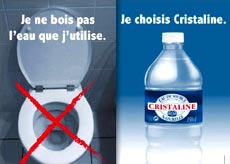 I wrote a note in French on this subject in June 2006 in my "Réactions" page. The discussion has become quite animated after Cristaline launched their advertising campaign in January 2007.
As you can see, the campaign was provocative. Newspapers and the Internet began to boil with comments from their readers. For those understanding French, here is a selection. The readers express their guts feelings. Many of them have but a very remote understanding of the scientific aspects of the debate.
I wrote a note in French on this subject in June 2006 in my "Réactions" page. The discussion has become quite animated after Cristaline launched their advertising campaign in January 2007.
As you can see, the campaign was provocative. Newspapers and the Internet began to boil with comments from their readers. For those understanding French, here is a selection. The readers express their guts feelings. Many of them have but a very remote understanding of the scientific aspects of the debate.
Plastic bottles litter our beaches and shores. When degrading, they produce minute particles that end up in our rivers and oceans.


Ground water depletion
The food industry giants are recklessly drawing on the water table, selling water that costs them almost nothing and belongs to the community at € 1 per litre, thus making a considerable profit at the expense of the citizen. Examples include:
In times of drought, these companies are causing groundwater levels to fall dangerously low, so much so that in some communities it is no longer possible to build new housing because they cannot be assured of an adequate supply of drinking water.
Conclusions
The taste of water
A quite subjective issue. Nevertheless, here are two criteria:
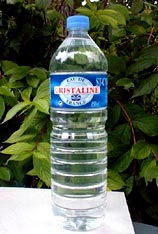
Waters with more than two grammes of dissolved salts (see Vichy for instance) may have a salty taste. Chlorine becomes noticeable when its concentration exceeds about 0.2 mg/L. Anything else is more psychological. In the case of Cristaline, there cannot be a common taste, as the different bottling sources have big differences in salinity.
Dry residue
The degree of mineralisation of water can be described by its dry residue value, which is also called "total dissoved solids" (TDS). The dry residue is measured by evaporating totally a sample of water, and weighing the minerals left in the container after evaporation.
| Type | Dry residue |
|---|---|
| High | > 1500 mg/L |
| Medium | 500 to 1500 mg/L |
| Low | 50 to 500 mg/L |
| Very low | < 50 mg/l |
Newborns do not eat cured ham
What? The issue is nitrate, and I mean three different things:
Nitrate and nitrite salts, formerly called salpeter, are used to prevent the growth of harmful bacteria that can cause a deadly illness: botulism. Besides—and this is commercially important—they preserve the red colour of meat. Permitted doses are 300 mg/kg of nitrate and 150 mg/kg of nitrite, to be compared wiith 50 mg/kg (= mg/L) nitrate and 3 mg/L nitrite recommended by WHO for drinking water. This being said, an excessive consumption of nitrate containing products such as cured meats is probably not healthy.
The nitrate found in surface and underground water originates from an excessive use of fertilisers. Additionnally, extensive pig farming is also a big polluter. The underground water of French Britanny is heavily contaminated with nitrates, and the farming lobby is strong enough to prevent the implementation of restrictive regulations.
Chlorine and Co
Drinking water stations must guarantee that the water they distribute is free from pathogenic bacteria. The classical way to kill the germs is an injection of chlorine in the water. As chlorine itself is a gas, hazardous and difficult to handle, sodium hypochlorite—a source of chlorine—is used instead. This is what everyone knows under the name of domestic bleach. Unfortunately, chlorine has a bad taste (remember the swimming pool) and also creates obnoxious by-products such as chloramines. Chlorine dioxide produces fewer of these and is more efficient altogether.
Ozone can also be used instead of chlorine. Once dissolved in the water it has no taste. All these chemicals are strong oxidants, but have a low toxicity at the commonly used dosage.
For continous and permanent efficiency, one of these oxidants must be present in the water up to the tap in our house or flat. There are several ways to eliminate chlorine in the tap water before you drink it:
Other products or methods can be used to prevent the growth of bacteria, but they are more expensive or difficult to apply for a city or village. On a small scale, silver salts or ultra-violet lamps can be used, and of course in emergency cases the water can be boiled.
Calcium, hardness and scaling
Most consumers think that calcium is good for health, and they are right. Several mineral water producers advertise the calcium content of their products as healthy. They are not totally right, as the human body does not assimilate well the calcium present in drinking water. The calcium in dairy products, green vegetables and other food is assimilated more easily.
The same consumers know that "hard" water causes whitish deposits of scale in the kettle and in the water pipes and hot water boiler. What many don't realise is that the scale is precisely made of calcium carbonate. In other words, calcium is good for my bones but bad for the electric coffee machine.
Many years ago, a battle was staged against the evils of water softening. The arguments were that water without calcium was unhealthy, and the increased sodium concentration of the soft water was harmful. These arguments did not hold, though: first the people drinking water with low calcium content (as found in Britanny, Scotland and many other regions of the world) did not suffer from specific ailments when compared to those drinking calcium-rich water, and second, the quantity of sodium (from table salt) that you ingest when eating French fries, ham or salted fish is much higher than that in a few glasses of water.
Summary:
Boiling water
No, this is normally not necessary in our region. However, when one is not sure of the bacteriological quality of the water, boiling it for 10 to 15 minutes (a long time...) will ensure that all harmful bacteria and viruses are killed.
Caution: boiling the water does little else: it does not remove inorganic (heavy lmetals etc.) or organic (pesticides etc.) contaminants. However, it does remove dissolved gases, such as chlorine, carbon dioxide and oxygen; it also precipitates the temporary hardness in form of calcium carbonate.
Is it harmful to boil water twice or more? This type of nonsense was found on the web. A good detailed reply is here. Boiling water more than one time doesn't add anything to it. It just removes water by evaporation while boiling. If you keep heating the water too long, all H2O will disappear and you'll be left with a concentrate of the substances originally dissolved.

Drinking recycled water?
All the water we drink, be it from the tap or from bottles, has been recycled by mother nature. See here a detailed picture of the hydrological cycle. Our tap water comes either from underground sources (deep wells) or from rivers or lakes. For distribution as drinking water, the surface waters are submitted to various treatments, mainly filtration and disinfection. In some cases—and this also applies to deep wells— additional treatments are carried out to eliminate specific contaminants such as arsenic, heavy metals, nickel, uranium, boron, and more frequently nitrate. The technologies used are mainly filtration on semi-permeable membranes (nanofiltration or reverse osmosis) or ion exchange. See for instance the page on drinking water in my ion exchange site.
Vichy water is not drinking water
This is one example, from France where I am living, but there are many other cases in different countries. See the Ukrainian example in the table above. Vichy is a mineral water sold for its claimed therapeutic or prophylactic properties.
| Component | Concentration | Comments |
|---|---|---|
| Bicarbonate | 4368 |
The recommended values given by the World's Health Organisation (WHO, 2004) are listed in the attached large PDF file.
Total salinity of this water is about 6.5 g/L (6500 mg/L), a high value, although there is no official limit. The fluorine content at 9 mg/L is very high. The recommended concentration is 1.5 mg/L or less. This single property makes the Vichy water non-potable. *Update: Since 2010, the bottle label shows 1 mg/L instead of 9 mg/L previously. The producer was asked about that and he confirmed that the fluoride level has been reduced since 2008, but he did not mention by which process. All other concentrations are unchanged. The French law does not allows mineral water to be treated by any process other than aeration, settling, and filttration. |
| Sodium | 1708 | |
| Chlorure | 322 | |
| Potassium | 132 | |
| Sulphate | 174 | |
| Calcium | 90 | |
| Fluoride | 1* (9) | |
| Magnesium | 11 | |
| Dry residue at 180°C | 4474 | |
| pH | 6.6 |
Vichy water is sold in the pharmacy and has been authorised by the French government based on its claimed beneficial effects on the liver and pancreas. Interestingly, the site "Eau de Vichy Saint-Yorre", used to show a warning: "In addition, one should remember that thermal water is a very active medicine: drinking it without a medical advice given by a competent doctor may result either in the cure being inefficient, or sometimes in serious incidents." This warning has disappeared in 2018, but is still there on another site: Auvergne Centre France.
See the Wikipedia definitions of drinking water and bottled water.
The Brita filter
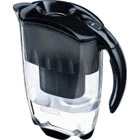
I am mentioning Brita because it is the filter I have in my kitchen. There are many other brands. I use the filtered water exclusively for tea and coffee: with the filtered water, tea is transparent, whereas if I prepare it from Paris tap water — that has a high calcium content — it is slightly cloudy due to the precipitation of calcium carbonate. And my Nespresso coffee machine is as new after four years and never requires de-scaling. If I had to use bottled water instead, I should take one wiith low salinity or at least low calcium.
These items are sold as jugs that contain the filter cartridge itself. The cartridge is filled with activated carbon, that removes the chlorine and some of the organic molecules, and with an ion exchange resin that removes the hardness. Traces of silver are incorporated in the carbon as a bacteriostatic agent that should prevent the growth of germs in the filter. As my consumption is moderate, I change the cartridge only every six to eight weeks.
When I want to drink a glass of water, however, I draw it from the tap without using the filter. In the district where I live, the tap water has no noticeable taste.
Ecological and political aspects
In Western Europe, we are lucky to live in countries where drinking water is available everywhere, where it is very carefully and severely controlled, and where its cost is very low (see below). When I go to India, I don't enjoy this luxury, and I drink exclusively bottled water. I consider as absurd and dangerous the reluctance that many French people have to drink tap water. Absurd, because as we have just seen, its quality is excellent and its price low. Dangerous, because if the population continues to mistrust the tap water, this could lead the authorities to reduce their efforts to produce excellent quality drinking water at the tap.
The consumption of bottled water has many disadvantages, in addition to its high cost. The drawbacks are more due to the bottle than to its content:
The price of water
In France, the price of drinking water varies between 1 and 6 €. In Paris, a cubic metre (1000 litres) of water costs 3.23 €/m3 in January 2014. The large difference between the local prices is due to the distance between the source and the point of distribution, and to the type of treatment. In 2013, the mean tap water cost in France was around 4 € per cubic metre. In Germany, it was about 5.30 €, in Italy about 1.20 €, and in Spain, about 2.40 €. As a comparison, the following table lists the price of bottled water in a typical large French supermarket (in May 2014), based on six-packs of 500 ml bottles:
| Type | Price in €/L |
|---|---|
| Tap (Paris) | 0.0032 |
| Cristaline bottled water | 0.52 |
| Evian | 1.08 |
| Vichy St-Yorre | 1.18 |
| Badoit | 1.64 |
| Perrier | 1.36 |
Of course one can indulge in luxury from time to time: I love the Perrier water bubbles in my Scotch (blended) whisky.
One problem remains: micropollutants
Although drinking water treatment plants eliminate all the usual pollutants (heavy metals, organic and microbiological matter), a certain number of contaminants in very low concentrations (in the nanogram or even picogram per litre range) are not always retained, except possibly by activated carbon. Some of these are medicines, hormones and insecticides, the former two being discharged with our urine, the latter infiltrating the water tables in regions of intensive agriculture. There are questions about possible health effects due to the combined action of these micropollutants. These pollutants have a proven effect on aquatic fauna. There are questions about possible effects on human health due to the combined action of these micropollutants. This problem does not only concern water, but also many food products, such as fish, vegetables and fruit.
Bottled water also contains plastic residues originating from the bottle itself. In January, 2024, a study published in «Proceedings of the National Academy of Sciences» shows that bottled water contains about 200'000 plastic particles per litre, of which 90 % nanoplastics, which are the most toxic.
Drinking water in Europe also contains such particles, bit much less: by drinking 1,5 litre water each day, you would need 40 years to ingest 1 milligramme. In America, there is much more.
Traditional filtration does not remove nanoparticles. To achieve this, you need reverse osmosis.
Links
© François de Dardel

Opinions